| Software Music Machine Archive |
|
SaxLab v2.2.1
|
|
Operating System:
File Size:
13.8 MB
License:
License Conditions: The Demos are fully functional. The only restriction that applies to demo versions is that they emit a noise about once every minute. The license fee is 149 US$ / 129 Euro. System Requirements: VST2.0 or AU capable host software, a screen resolution of 800x600 or higher, 100 Mb free space on your harddrive. 700 Mhz CPU, 256 Mb RAM. Last Updated: 2015-04-01
For more detail about software : Software Description
|
View SaxLab v2.2.1 Screenshot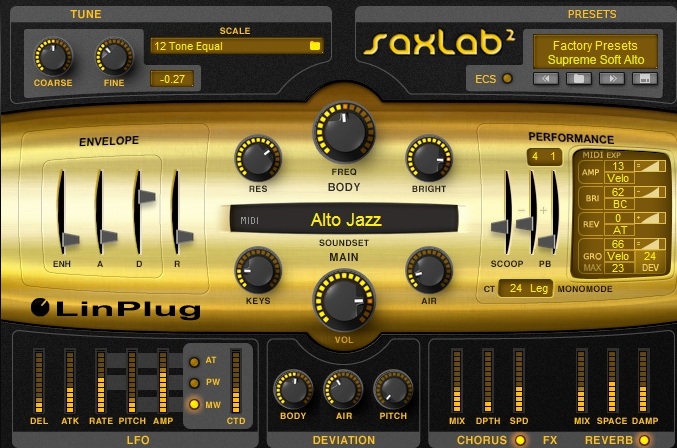 |
Software Description
SaxLab is the result of many years of investigation and programming. It uses not one technology but a very carefully balanced mixture of various techniques to obtain the most realistic sax sound you can get from a virtual instrument. Authenticity, Expression and Variation is a must to obtain believable sax sounds.
Key features include an easy-to-use interface, a wide range of high-quality soundsets for bass, baritone, tenor, alto and soprano saxophone. An effects section that includes a specialized chorus and reverb, as well as extensive real-time modulation options.
Special attention has been paid to making the performance controls as rich and responsive as possible, so that the instrument can be realistically played.
Inspirational SoundSets combined with an easy-to-use interface make the LinPlug SaxLab the ideal virtual instrument for musicians wanting to emulate real saxophones.
Features:
- High-Quality Soundsets for bass, baritone, tenor, alto and soprano saxophone.
- Monophonic with "real sax" behaviour.
- Adjustable mix of the "Air" layer, the "Keys" layer and the main tonal layer.
- User-definable, velocity-sensitive amplitude envelope.
- Tonal characteristics of the instrument's overall sound are user definable.
- Real-time control of amplitude, brightness and the "roaring" of the sound.
- Three modes of mono performance: Legato, Retrigger and Alternate.
- Separate control of Up/Down PitchBend and Scoop.
- Adjustable pitch, air and body frequency deviation per note.
- Envelope, LFO and MIDI-controlled vibrato and tremolo.
- Specialized Stereo Chorus and Stereo Reverb effects.
- Full Micro Tuning capability (loads TUN files).
- MIDI Learn available for every control.
- Sample accurate timing, full automation and settings are saved with the song.
New in v2.2.1
- Fixed slow startup
New in v2.1.8
- Removed option which prevented editor to appear
New in v2.1.6
- Bugfix for potential crash
- Manuals updated
New in v2.1
- 64-bit version of AudioUnit and VST plugin.
- Added support for Mac OS X 10.7 invert mouse scroll.
- Better Stability
New in v2.1
- 32 and 64 bit PC version available.
- Compatible with Windows XP, Vista and Windows 7.
- Improved preset menu structure.
- Fixed GUI flicker in REAPER.
